
Local SEO checklist for Hampshire small businesses
A plain-English local SEO checklist for Hampshire small businesses: Google Business Profile, citations, map pack and on-page steps you can work through.
Short answer: Local SEO for small business is the work that helps nearby customers find you on Google Search and Maps. For a Hampshire cafe, trades firm, clinic or shop, that means your Google Business Profile, consistent contact details, directory listings, reviews and a few on-page signals on your website.
A checklist is more useful than a vague plan to "do SEO", because each step has a way to check it and a way to fix it. This one is written for Hampshire firms around Farnborough, and it follows Google's own help rather than ranking promises.
Local SEO for small business: what you are aiming for
You are aiming to show up when someone nearby searches for what you sell.
When someone searches for a service in their town, Google often shows a map and a short list of nearby businesses. That list is the local pack, or Google Map Pack. Your Google Business Profile feeds much of what appears there.
Google's tips to improve your local ranking say local results are "mainly based on relevance, distance and popularity". Prominence includes reviews and "how many websites link to your business". Google also says "There's no way to request or pay for a better local ranking on Google", and that "Businesses with complete and accurate info are more likely to show up in local search results".
Nobody can promise you a place in that pack. The useful work is a complete profile, consistent details and services you actually offer.
The local SEO checklist
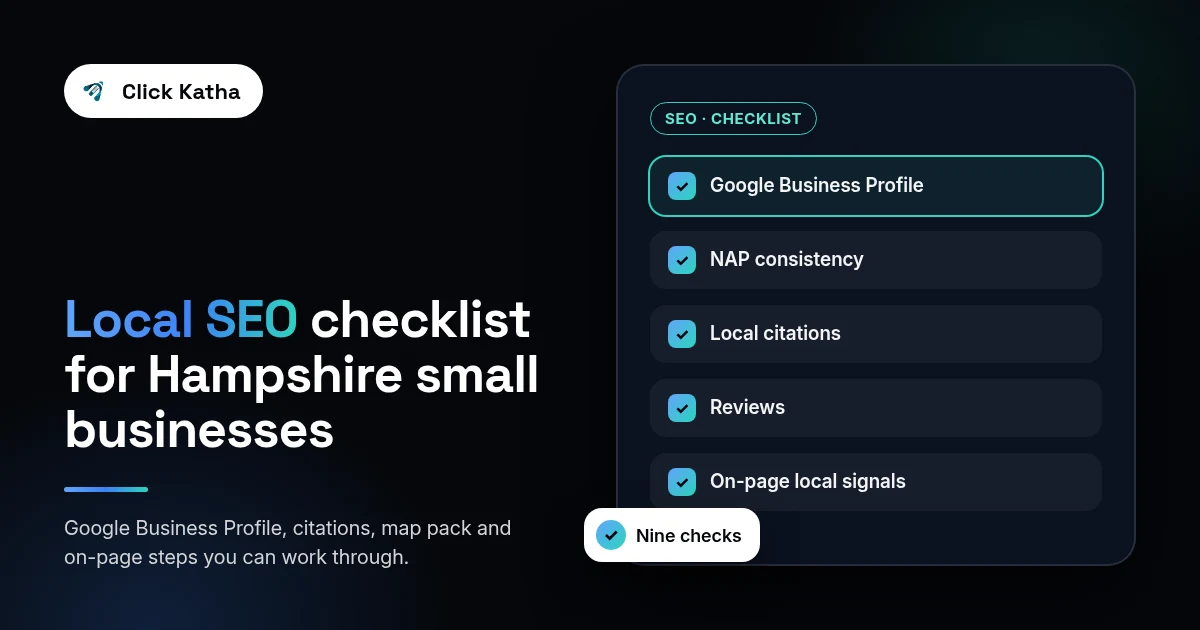
Nine checks. Each one says what it is, how to check it and what to do.
1. Claim and complete your Google Business Profile
Your profile is the listing Google uses for Maps and many local results. Claiming it (Google calls this verification) shows you are allowed to manage the business. Completing it means adding category, address or service area, hours, phone number, description, photos and services.
How to check: search your business name. If a profile appears, confirm you can manage it. If details are thin, out of date or claimed by someone else, start there. The full walkthrough is our Google Business Profile checklist. This post does not repeat it.
2. NAP consistency (name, address and phone)
NAP is the name, address and phone number you use in public. They should match on your website, your Google Business Profile and the main directories that already list you.
How to check: compare those sources for Ltd against Limited, a missing unit number, a postcode written two ways, or +44 against a leading-zero phone number.
What to do: use the details on your shopfront, van or stationery everywhere. Do not invent a second public address.
3. Local citations
Local citations are mentions of your business name, address and phone number on other websites. Well-known UK directories such as Yell and Thomson Local are examples, not a list you have to buy. Quality matters more than volume.
How to check: search your exact business name and town, then open the listings you already have. Claim any unclaimed profile and correct mismatches before you add new ones. Skip bulk-submission offers that promise hundreds of listings.
4. Categories and services that match how customers search
Google uses your primary category to understand what your business is. Its category guidance says: "The categories that you select affect your local ranking on Google." Pick the most specific true option from Google's list; you cannot invent your own.
Additional categories are for real extra services, not every phrase you would like to rank for. Describe services in the words customers type, if you actually provide them.
How to check: read the primary category as "This business is a [category]." If that sentence is a stretch, change it.
5. Photos, products or services, and weekly Google Business Profile posts
Use photos of the real premises, team or finished work, with permission. Add products or services only when they are accurate.
Google does not require a posting schedule. A weekly habit is useful if you add a genuine update, such as new photos, changed hours or a real event.
How to check: open your profile as a customer would. Are the photos current, the services listed and the last post still useful? These are profile updates, not advertising.
6. Reviews: ask honestly, never offer incentives or gate them
Google allows you to ask for a genuine review. It does not allow you to buy, filter or script the outcome.
Google's tips for getting more reviews say that offering incentives, "like free of cost or discounted goods or services, in exchange for customers to post reviews, change reviews or remove negative reviews is considered fake engagement and is strictly prohibited." Google's Maps content policy also says merchants may not "discourage or prohibit negative reviews, or selectively solicit positive reviews from customers". That is review gating: a different ask or link for customers you think are unhappy. The same policy says not to pressure people to review while they are on your premises.
Ask every customer the same way, with the same Google review link. Reply in your own words. Do not offer discounts, gifts or a prize draw for a review, or give staff a script that invents a reply.
7. On-page local signals
Your website should back up the profile: the same name, address and phone number on the contact page, and your town in a title or H1 only when it is true. A Farnborough clinic can say Farnborough. Do not add Aldershot to a title if you do not serve Aldershot.
If customers visit you, embed a Google Map using your real address. If LocalBusiness structured data is already on the site, check it matches the profile and the visible page. Do not invent markup.
Technical issues can still stop a local page appearing. Our technical SEO checklist covers crawl and index fixes that sit alongside this local work.
8. Google Map Pack and local pack basics
The Google Map Pack is the map-and-list block that often appears for a local-service search. It is the same idea as the local pack, drawn largely from Google Business Profiles.
How to check: search as a customer would, such as your main service plus your town, on a phone and a computer. Results can vary by location, so treat this as a sense-check, not a score. You cannot pay Google for a higher place in that pack. Only claim towns you actually serve.
9. Track your searches in Google Search Console
Google Search Console is "a free service offered by Google that helps you monitor, maintain, and troubleshoot your site's presence in Google Search results". You do not need it for pages to appear, but it shows the queries and pages Google already associates with your site.
How to check: once verified, open the Performance or Search results report. Use Queries for the phrases that showed your site, and Pages for the URLs. Note what you see this month rather than inventing a baseline, then look again after changes. Profile activity and Search Console clicks are not the same, so read both.
Local SEO tips that fit Hampshire
Distance is one of Google's three local factors, so a Farnborough business and one across the county are not competing for every nearby search. Name only the towns you serve.
From our Farnborough base we support businesses in Farnborough, Fleet and Aldershot. That is service coverage, not a claim of staffed offices in each town. If you serve Fleet, say so; if you do not, do not add it to a title, category or service area.
Write pages for places you can actually reach, not thin town pages that only swap a name. Keep the profile service area honest. See SEO in Hampshire for how we describe that Farnborough base.
How to do local SEO without doing everything at once
You do not need to finish this list in a week. Work in this order:
Claim and complete your Google Business Profile.
Make your name, address and phone number consistent, then tidy existing citations.
Ask every customer for a review in the same way.
Add on-page local signals on your contact and service pages.
Measure queries and pages in Search Console, and your profile activity, before deciding what to do next.
If a later item depends on an earlier one, finish the earlier step first.
When to get help
Our local SEO services cover this work if you would rather not manage it yourself. Hampshire firms can also read about SEO in Hampshire, based in Farnborough, for the towns we actually cover.
If you are comparing budgets first, you can see our SEO pricing or read about how much SEO costs for a small business. Nobody can promise a ranking, a map-pack place or a timescale, and we will not.
FAQs
What is a local SEO checklist?
A local SEO checklist is a set of practical checks for appearing in local Google Search and Maps results. It typically covers your Google Business Profile, consistent name, address and phone details, citations, reviews, on-page town signals and a way to measure search queries.
How is local SEO different from regular SEO?
Regular SEO helps your web pages appear for searches, including ones with no particular place attached. Local SEO focuses on searches with a location, such as a town name or "near me", and on Google Maps and the local pack. Your Google Business Profile, citations and reviews matter here, alongside your website.
How long does local SEO take for a small business?
It usually takes weeks to months of steady work, not a single afternoon. How quickly anything changes depends on competition, how complete your listings already are, and what Google already shows for your searches. Nobody can promise a ranking, a map-pack place or a date.
Do I need a Google Business Profile for local SEO?
For most cafes, trades, clinics and shops that customers look up nearby, yes. The profile is the listing Google uses for Maps and the local pack. You can still tidy your website and citations without one, but you will miss that main local listing. The Google Business Profile checklist above covers setup.
What are local citations?
Local citations are mentions of your business name, address and phone number on other websites, such as well-known UK directories. Quality matters more than collecting every possible listing. Each citation should match the details on your website and Google Business Profile.
Can I do local SEO myself in Hampshire?
Yes. A Hampshire owner can work through this checklist with Google's free tools and their own website. Start with your Google Business Profile, then consistent contact details, citations and honest review requests. If the work stalls, that is when to get help.
Your next step
Work through the list in that order, then check Search Console and your profile before adding more tasks. Local SEO for small business is upkeep, not a one-off project. Keep the profile complete, the details consistent and the reviews honest.
Local SEO and organic social work together. The same genuine update can live as a profile post and on the channels our social media management covers.